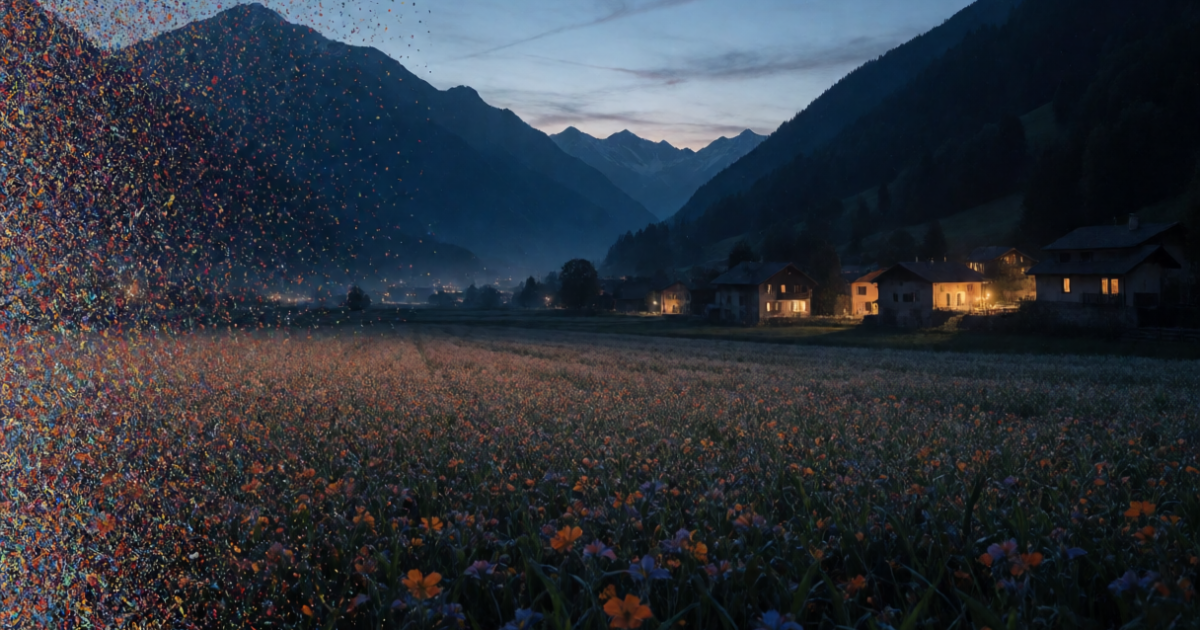
Two open-weights image models bracket the modern era of AI image generation. Stable Diffusion, released in August 2022, made text-to-image generation something anyone could run on a gaming GPU, and its descendants still power most of the community’s tooling. Krea 2, released as open weights on June 22, 2026, is what the same idea looks like after four years of hard lessons: a 12 billion parameter diffusion transformer, trained through a five-stage pipeline borrowed half from the LLM playbook, shipped under a license that would have been unrecognizable in 2022.
Comparing them is not really a product shootout. The interesting question is structural: hold the two models up side by side and you can read, component by component, what the field learned and what it abandoned. That’s what this piece tries to do, at a level of detail that’s usually scattered across a dozen papers and technical reports. Load-bearing technical claims below are linked to papers, model cards, court judgments and the companies’ own reports; where a number comes from a vendor’s self-description, it’s attributed as such rather than asserted.
Background: what a diffusion model is, in one section
Both models belong to the same family, so the shared machinery is worth stating once.
A diffusion model learns to reverse a corruption process. Take a real image, add a little noise, add a little more, and repeat until nothing remains but static. That forward direction is trivial. The model’s job is the reverse: given a noisy image and a description of how noisy it is, predict something about the clean image underneath (the noise itself, or the velocity pointing toward the clean image, depending on the parameterization). Generation then starts from pure noise and applies that denoising prediction repeatedly, guided at each step by a text prompt, until an image condenses out. The theory traces to Sohl-Dickstein et al. (2015) and the modern formulation to Ho et al.'s DDPM paper (2020).
Doing this directly on pixels is brutally expensive. The insight that made consumer-hardware generation possible came from Rombach, Blattmann, Lorenz, Esser and Ommer (2021): run the diffusion process not on pixels but in the compressed latent space of a separately trained autoencoder, roughly 8x smaller in each dimension, and decode to pixels only at the end. Their “latent diffusion model” paper is the single most consequential design decision in this story, because every model discussed below, including Krea 2 in 2026, still works this way. Backbones, objectives, data and licenses were all replaced over the following four years; the latent-space frame outlived every one of them.
Stable Diffusion, 2022: the accidental standard
Stable Diffusion was the latent diffusion architecture trained at scale and, crucially, released with open weights in August 2022 by the CompVis group at LMU Munich, Runway, and Stability AI. The original model was modest by current standards: a roughly 860 million parameter U-Net denoiser, a frozen CLIP ViT-L/14 text encoder for conditioning via cross-attention, and a VAE compressing 512x512 images into 64x64 latents (Rombach et al.; model card).
The training data was as important as the architecture, and it became the most contested part of the whole project. Stable Diffusion trained on subsets of LAION-5B, a 5.85 billion image-text-pair dataset assembled from Common Crawl web scrapes, filtered by CLIP similarity and, for the aesthetic subsets, by a learned attractiveness score. This was open science at its most radical: the dataset was public, documented, and inspectable, which is exactly how researchers and journalists could later enumerate what was inside it, copyrighted material, private photos and all. No frontier lab discloses training data at that granularity anymore. The licensing section below gets into why.
What made Stable Diffusion an era rather than a paper was everything that grew on top of it within about a year. Low-rank adaptation (LoRA), imported from the LLM world, let anyone fine-tune the model on a specific face, style, or object in an afternoon on consumer hardware and share the result as a file measured in megabytes. ControlNet (Zhang et al., 2023) added structural conditioning, pose skeletons, depth maps, edges, that turned a text-to-image toy into a controllable production tool. Web UIs (AUTOMATIC1111, later ComfyUI’s node graphs) gave the whole stack an interface, and model-sharing hubs accumulated hundreds of thousands of community fine-tunes. The pattern this established, base model as commons, LoRA as the community’s unit of contribution, is the same contract Krea 2’s entire release strategy is organized around four years later.
The lineage: from U-Net to transformer, and a fumbled handoff
Stable Diffusion’s own successors tell the architecture story of the next four years.
Even version 1.x had a complicated custody arrangement that foreshadowed later drama: the widely used 1.5 checkpoint was published in October 2022 by Runway, Stability’s research partner on the original work, rather than by Stability itself, a reminder that “Stable Diffusion” was never one company’s clean product line. Stable Diffusion 2 (late 2022) swapped CLIP for an open text encoder and retrained on a more aggressively filtered dataset, and is mostly remembered for teaching the field that a technically better-behaved model can lose to an ecosystem: the filtering degraded exactly the subjects communities cared about fine-tuning, and the crowd largely stayed on 1.5, where its fine-tunes and tooling lived. SDXL (Podell et al., 2023) scaled the U-Net to roughly 2.6 billion parameters, added a second text encoder, and trained at 1024x1024. It became, and to a remarkable degree remains, the community workhorse: even in 2026, practitioner guides keep recommending the SDXL ecosystem for its depth of LoRAs, ControlNets and inpainting tooling rather than for the base model itself.
The real architectural break came with Stable Diffusion 3 (Esser, Kulal, Blattmann et al., 2024), which replaced the U-Net with a multimodal diffusion transformer (MMDiT), processing image and text tokens jointly, and replaced the noise-prediction objective with rectified flow, learning straight-line paths between noise and data that are cheaper to traverse in few steps. That paper set the template nearly every serious image model now follows, Krea 2 included.
Then Stability nearly fumbled the whole franchise. The June 2024 release of SD3 Medium arrived visibly damaged in the one place users would test first: human anatomy, with mangled limbs in ordinary poses. It shipped under a new noncommercial-by-default license the community read as a rug-pull, and hobbyist infrastructure reacted by restricting or banning SD3-based models. This happened against a backdrop of corporate chaos, well documented at the time: founder Emad Mostaque resigned as CEO in March 2024, and the company was recapitalized under Prem Akkaraju that June. The October 2024 release of Stable Diffusion 3.5 (Large at 8 billion parameters, a distilled Large Turbo, and a 2.5 billion parameter Medium) was in large part an apology tour: better models, and a rewritten community license that allowed free commercial use for anyone under one million dollars in annual revenue. That specific number turns out to matter beyond Stability.
One more thread matters. In 2024, the core authors of the original latent diffusion and SD3 papers, Robin Rombach and Patrick Esser among them, left Stability and founded Black Forest Labs, whose FLUX models became the de facto quality leaders among open image models. The intellectual lineage of “Stable Diffusion,” in other words, forked away from the company that owns the trademark, and Krea 2’s family tree, it turns out, runs partly through Black Forest Labs rather than Stability.
Krea 2, 2026: what a from-scratch model looks like now
Krea is a creative-tooling company, best known for a realtime canvas where generation happens as you draw and for aggregating frontier models behind one interface. Its first move into training was a 2025 collaboration with Black Forest Labs on FLUX.1 Krea [dev], an “opinionated” open-weights model explicitly aimed at the oversaturated, plastic-skinned default look of AI imagery. Krea 2 is the follow-through at foundation scale: a from-scratch model whose stated thesis, per the technical report, is that “as the field has optimized for reliability… many systems have converged toward a narrow set of default aesthetics,” making them “less effective as engines for creative exploration.”
The concrete artifact: a 12 billion parameter diffusion transformer, released June 22, 2026 in two open-weights checkpoints. Krea 2 Raw is the undistilled base, which the model card bluntly describes as “not recommended for inference use” but ideal for fine-tuning; its reference configuration runs 52 sampling steps. Krea 2 Turbo is the post-trained, distilled checkpoint meant for actual generation. The division of labor is explicit in Krea’s own framing: “Train LoRAs on RAW, then run them fast on Turbo.”
Architecturally, the technical report reads like a checklist of post-SD3 refinements. The backbone is an MMDiT-style transformer with grouped-query attention using gated sigmoid attention, SwiGLU feedforward layers, zero-centered RMSNorm with QK normalization, and 3D axial rotary position embeddings. Two details stand out as more than tuning. First, the per-block adaptive layer norm modulation that DiT-family models use to inject the timestep, which Krea notes “can account for 20-30% of the total parameter count,” is replaced with a lightweight per-block bias, spending those parameters elsewhere. Second, the text encoder is not a contrastive model like CLIP or a text-to-text model like T5 but Qwen 3 VL, a full vision-language model, chosen after ablations because “a VLM offers a richer input space (text and image) and stronger multilingual generalization.”
One fact about this “from scratch” model says a great deal about the 2026 ecosystem: it is assembled from other labs’ open components. The autoencoder story is explicit in the report: Krea “initially used the Qwen Image autoencoder to scale our early models and later adopted the FLUX 2 VAE for our larger models.” The text encoder is Alibaba’s. The VAE is Black Forest Labs’. A frontier-adjacent image model in 2026 is less a monolith than a composition over the open ecosystem’s best parts, which is a form of progress Stable Diffusion itself made thinkable: in 2022 there was essentially one open VAE worth using, and it shipped with SD.
The headline feature is style control. Krea 2’s style-reference system accepts one or more reference images and, per the report, supports smooth semantic mixing of multiple styles, continuous strength control per reference, and what the company describes as “state-of-the-art adherence to complex styles,” trained with a self-supervised method designed to fight the classic failure mode where “content and subject matter” leak from the style image into the output. That “state-of-the-art” is asserted rather than benchmarked in the report, worth noting. The moodboard-with-sliders workflow is the productized version of what the SD community has approximated for years with LoRA stacking and weighted merges.
The report is also clear about what Krea 2 does not do yet. Reliable image editing, image-based subject reference, and native 2K to 4K generation are all listed as future work rather than shipped capabilities; the released models were trained through a 256, 512, 1024 pixel resolution ladder, with higher native resolutions gated on sparse-attention work still to come. Anyone comparing headline resolution numbers across model marketing pages should keep that distinction, native generation versus upscaled output, firmly in hand, since it’s one of the most commonly blurred lines in image-model marketing.
Training: the LLM playbook arrives in image land
Put the two training recipes side by side and the four-year gap is at its widest.
Stable Diffusion’s 2022 recipe was, in essence, one stage: filter a web-scale scrape with CLIP scores and an aesthetic model, train the denoiser on it at 256 then 512 pixels, ship. What the model learned was whatever the scrape contained, and its famous failure modes (text rendering, hands, prompt-blindness to composition) were downstream of captions that were mostly alt-text.
Krea 2’s pipeline, per the technical report, runs pretraining, midtraining, supervised fine-tuning, preference optimization, and reinforcement learning, with an optional distillation stage after that. Each stage imports something the language-model world spent 2023-2025 standardizing.
The data philosophy inverted twice over. Where LAION was filtered toward a learned aesthetic score, Krea explicitly refuses model-based aesthetic filtering, arguing such filters “may classify a blurry image as low quality, even though motion blur or softness can be a deliberate artistic choice.” And where 2022-era datasets were unavoidably pre-AI, Krea now has to filter AI-generated images out, and states flatly that “even a small proportion of AI-generated images introduces biases into the model’s output distribution, as synthetic images tend to be easier to learn, which effectively imposes an upper bound on model quality.” Four years after Stable Diffusion flooded the internet with its outputs, the primary contamination hazard for a new image model is the previous generation of image models. The report describes pretraining data “on the order of billions of images,” captioned by VLMs with an OCR pass folded in, and concept coverage audited against roughly five million Wikipedia-derived concepts, a level of dataset engineering that simply did not exist in the LAION era, and also a level of dataset disclosure far below it: we know how LAION was built row by row; for Krea 2, as for nearly all current models, we get a methodology description and the phrase “publicly available data, data licensed from third-party providers, and synthetic data” on the model card.
The post-training stages are where the LLM influence is unmistakable. Supervised fine-tuning uses small hand-curated sets per visual domain, merged back into a generalist checkpoint. Preference optimization runs a large synthetic-pairs stage and then a human-annotation calibration stage, using a DPO variant Krea calls STPO, modified because vanilla DPO’s policy divergence “manifests as high-frequency artifacts.” The reinforcement learning stage is a multi-reward, GRPO-style method with separate reward models for aesthetics, prompt following, text rendering, and, tellingly, a dedicated artifact reward targeting reward hacking, “images that appear plausible at first glance while containing structural artifacts such as extra fingers, malformed limbs, or distorted text.” Hands, the joke failure of 2022, now have their own reward model. The RL stage trains without classifier-free guidance entirely, leaving CFG available at inference as “an additional control knob” rather than a crutch.
Turbo, the checkpoint most people actually run, comes from a final distillation stage using trajectory distribution matching (TDM), compressing the many-step sampling of the base model into a few steps, the same design goal as SD 3.5’s Large Turbo, reached via a newer method.
The report also contains two admissions of a kind companies rarely publish. On scale: “we find that our current models are undertrained and would benefit from longer training.” And on infrastructure, describing large distributed runs: “we did not complete a single run at very large scale that exceeded 24 hours without a crash.” Anyone who thinks 2026-era training is a solved industrial process should read that section twice.
The unglamorous machinery: data curation and infrastructure
Because the Krea 2 report is unusually candid about plumbing, it offers a rare measured look at what “training an image model” means operationally in 2026, and the contrast with the LAION era is instructive at every step.
Consider what replaced the CLIP-score filter. To audit whether the training distribution actually covers the world’s visual concepts, Krea ranked English Wikipedia articles with PageRank, kept the top 90 percent, and used the resulting roughly five million concepts as a checklist, verified via full-text search over its captions. Deduplication runs on hierarchical k-means clusters over embedding space, with semantic near-duplicates pruned within leaf clusters. For artifact hunting, the team trained sparse autoencoders on SigLIP-2 image embeddings and used the resulting interpretable features as an unsupervised tagging system, finding clusters of watermarks, borders and compression junk that no hand-written rule anticipated. One concrete example of why this matters: the report traces a model tendency toward “flat-color backgrounds and border artifacts” back to specific data slices, the kind of causal data-to-artifact debugging that was simply impossible when a training set was a fixed public scrape.
Captioning got the same industrialization. Every image passes an OCR stage whose output is handed to a vision-language captioner along with metadata, and a cheaper language model then reformats each caption “into a variety of lengths.” The report notes that “training on long prompts provides dense supervision, yielding faster convergence and lower training loss,” a quiet but important finding: caption quality is a training-efficiency lever, not just a prompt-following one. Stable Diffusion learned from alt-text because alt-text was what the web had. Krea 2 learns from synthetic paragraphs describing palette, geometry and lighting, because captions are now manufactured, not found.
The infrastructure section is franker still. Training runs on a from-scratch PyTorch stack (FSDP2 sharding with tensor parallelism and asynchronous communication overlap), and the 256px and 512px stages run in 8-bit precision, which the team measured at “15-20% gains in training speed over a bf16 baseline.” Checkpointing to a parallel filesystem completes “in roughly 30 seconds,” which sounds like trivia until you read that at the largest scales the team “did not complete a single run at very large scale that exceeded 24 hours without a crash.” Fast checkpoints are not a convenience; they are the difference between a crash costing minutes and costing a day. The data warehouse behind curation holds 208 terabytes of metadata alone, metadata, not images. And in a detail optimizer researchers will appreciate, the team evaluated the Muon optimizer, found it “consistently outperformed the AdamW baseline” in their ablations, and still shipped on AdamW “owing to time constraints.” Anyone who has worked near a production deadline will recognize the shape of that decision.
None of this machinery existed around Stable Diffusion in 2022, and that absence was not a defect. The 2022 model was trained more or less the way a research lab trains a paper artifact, and it changed the world anyway. The 2026 model is trained the way a company runs a refinery. Both facts are true, and the distance between them is four years of the field professionalizing.
The prompt gap, and the model that rewrites your prompt
One consequence of the caption shift deserves its own section, because it changes what “prompting” means and complicates any naive comparison between generations of models.
Stable Diffusion 1.x was trained on short, noisy web captions, and its community learned to speak to it in kind: comma-separated tag soups, “masterpiece, best quality” incantations, negative prompts to steer away from deformity. Krea 2 was trained on dense, structured, machine-written descriptions, and models trained this way respond best to prompts shaped like their captions: long, specific, compositional. The report is explicit that user reality has moved even further, with people pasting tag lists, JSON fragments and bounding-box pseudo-code, such that “traditional natural-language prompting is no longer sufficient” as a description of the input distribution.
Krea’s answer is a dedicated prompt-expansion model: an open-source LLM post-trained (SFT, then RL) to rewrite a user’s underspecified prompt into the dense caption dialect the image model expects. The training details mirror the image side’s sophistication, multi-reward RL scoring the resulting images for quality and faithfulness, with safety gates. And it surfaces one of the most interesting failure modes in the whole report: optimized naively, the expander collapses toward “a single safe, high-reward house style,” the exact homogenization Krea 2 exists to fight, this time emerging inside a text model. The mitigation is a diversity reward computed over image embeddings across prompt groups, kept “active throughout training” because the collapse returns whenever it is removed. The lesson generalizes far beyond Krea: every preference-optimized system in this stack, image model, prompt model, or leaderboard, has a gravitational pull toward one crowd-pleasing mode, and diversity survives only where someone builds an explicit counterweight.
For comparison purposes the practical upshot is this: a 2022 model and a 2026 model given the same eight-word prompt are not being asked the same question. One is receiving input from inside its training distribution and the other far outside it, in one direction or the other. Fair cross-model comparison now requires either letting each model’s preferred prompting style speak for it, or holding raw prompts fixed and acknowledging the handicap, and being explicit about which choice you made.
The evaluation problem, still unsolved
How do you know which model is better? In 2022 the answer was FID (a statistical distance between generated and real image distributions) and CLIP score (text-image agreement), and both were already known to correlate poorly with what humans prefer. By 2026 the field has largely surrendered to preference: crowd-sourced pairwise votes aggregated into leaderboard rankings, most visibly the Artificial Analysis text-to-image arena.
Krea 2’s own competitive claim is carefully scoped to exactly that: the report states it is “among the top 10 models on the Artificial Analysis leaderboard for text-to-image, and scores 2nd place among models from independent labs.” The report contains no FID tables, no head-to-head win rates against named competitors, no benchmark grid of the kind SDXL’s paper still carried, and the absence tells you where evaluation has landed. Aggregate preference scores are the currency now, and they carry a known circularity: models post-trained on human preference climb leaderboards scored by human preference, whether or not the gains transfer to any individual user’s taste. Krea’s stated thesis, that optimizing every model toward one preference distribution produced the homogeneous “default aesthetic” it is positioning against, is a critique of the same measurement regime its own headline claim relies on. The report does not resolve that tension, and to be fair, nobody else has either.
For working purposes, the practical takeaway is older than either model: aggregate rankings do not answer the question “which model is better for my subject, my style, and my pipeline.” The only reliable instrument for that is the boring one, and since this site exists for it, here is the protocol in brief. Write five to ten prompts from your actual use case, not gallery bait. Generate a fixed number of images per prompt per model, keeping whatever each model’s recommended settings are (steps, guidance, its own prompt style per the section above), and resist the urge to cherry-pick before comparing; the misses are data. Then inspect winners against each other at native resolution, aligned, not in a thumbnail grid where every output looks equally competent. Thumbnails are where AI images are most persuasive and least informative; hands, text, texture continuity and background logic all live at 100 percent zoom. A draggable comparison of one model’s output against the other’s on the same prompt settles in seconds what a grid obscures, and the same method works for checking whether an upscale added real detail once you start pushing outputs beyond native resolution.
Licensing: the quiet convergence
The license story is where the two projects, and the whole open-weights economy, converged from opposite directions.
Stable Diffusion 1.x shipped under CreativeML OpenRAIL-M: free commercial use at any scale, with use-based behavioral restrictions. It is a large part of why the ecosystem exploded; startups built businesses on it without a single conversation with Stability, which is also why Stability captured so little of the value and had to renegotiate the social contract later. The SD3-era community license drew the new line at one million dollars of annual revenue: below it, free including commercial use; above it, pay for an enterprise license.
The Krea 2 Community License (v1, dated June 22, 2026) adopts the same architecture, with the same one-million-dollar trailing-twelve-month revenue threshold. This is now simply what “open weights” means commercially: free for individuals, hobbyists and small teams, metered for everyone else. But the Krea license is worth reading closely, because it also shows how much more legalized this territory has become. It obliges deployers to implement “reasonable and appropriate Content Filter measures” (naming example classifiers), requires derivative models to carry “Krea” in their name, terminates automatically if you litigate against Krea, and, most strikingly, allows Krea to terminate the license “for any reason upon thirty (30) days’ prior written or electronic notice.” A 2022-era OpenRAIL license had no such clause; weights, once released, were effectively feral. The 2026 version keeps a leash on paper, whatever its practical enforceability against copies already in the wild.
The legal backdrop shifted underneath both companies in the interim. In the first major ruling of its kind, the UK High Court in Getty Images v Stability AI (November 4, 2025) rejected Getty’s secondary copyright infringement claim, holding that model weights are not a “copy” of training images in the statutory sense, an AI model “contains statistically trained parameters, not stored copies,” while finding only narrow trademark liability over watermark generation, and never reaching the core question of whether training itself infringes, because Getty abandoned its primary claim on jurisdictional grounds. The narrow holding matters less than the climate it reveals: training-data litigation is why no 2026 model discloses its dataset the way LAION did, and why model cards now speak in the careful register of “publicly available and licensed data.”
Ecosystem: the community outlived every individual model
The most Stable-Diffusion-shaped thing about Krea 2 has nothing to do with architecture. It’s the release choreography.
Krea 2 arrived with a diffusers pipeline merged into Hugging Face’s library, ComfyUI support, SGLang serving, hosted endpoints on FAL, Replicate, Together and others, and a public LoRA-training workflow with the explicit contract that community LoRAs trained on Raw run on Turbo. By mid-July 2026, three weeks after release, the Hugging Face hub listed 184 adapters, 23 fine-tunes and 8 quantizations built against the Raw checkpoint, with monthly downloads in the low six figures (those counters move daily; the shape matters more than the digits). And when the team did its launch AMA, it held it on r/StableDiffusion, a subreddit named after a competitor’s four-year-old model.
Sit with that detail for a second. “Stable Diffusion” stopped being just a model years ago; it’s the name of a community and a stack of expectations: weights you can download, LoRAs you can train, node graphs you can wire, a hub where fine-tunes accumulate. Every subsequent open model, FLUX, Qwen-Image, and now Krea 2, launches into that community, on its terms, and is judged by how well it slots into the existing tooling. Stability AI, the company, spent 2024 nearly destroying itself and by 2026 remains active with SD 3.5 as its flagship image release. But the ecosystem it seeded no longer depends on it, and arguably the ecosystem, not any checkpoint, was the real release of August 2022.
The comparison in table form, for the record:
| Stable Diffusion (v1, 2022) | Krea 2 (2026) | |
|---|---|---|
| Denoiser | U-Net, ~860M params | Diffusion transformer (MMDiT-style), 12B params |
| Objective | Noise prediction (DDPM) | Rectified flow |
| Text encoder | Frozen CLIP ViT-L/14 | Qwen 3 VL (a full VLM) |
| Latent space | Own KL-VAE, 8x | Qwen Image VAE, then FLUX 2 VAE |
| Training data | LAION subsets, publicly enumerable | Undisclosed mix, curated, AI-images excluded |
| Post-training | None | SFT + STPO preference opt + multi-reward RL + TDM distillation |
| Fast variant | None at launch | Turbo (distilled) |
| License | OpenRAIL-M, unlimited commercial | Community license, $1M revenue cap |
| Native resolution | 512px | 1024px (2K-4K stated as future work) |
What actually changed, and what didn’t
Reading the two systems against each other, the changes sort into three tiers.
The wholesale replacements: U-Net gave way to transformers, noise prediction to rectified flow, contrastive text encoders to full VLMs, and one-stage training to a five-stage pipeline where most of the perceived quality is manufactured after pretraining, in preference optimization and RL. That last one is the deepest shift. A 2022 model’s aesthetic was an accident of its scrape; a 2026 model’s aesthetic is a deliberate, reward-modeled artifact, which is exactly why Krea can meaningfully market an aesthetic position and why the “AI look” became recognizable enough to position against.
The quiet constants: latent diffusion itself, unchanged in kind since the Rombach paper; the VAE bottleneck (Krea rejected a more aggressive autoencoder because it “imposes a hard upper limit on the diffusion model’s ability to resolve fine detail,” the same tension SD’s 8x VAE set up in 2021); LoRA as the community’s unit of participation; and the download-weights-and-tinker culture that turned out to be more durable than any company strategy.
And the reversals. Data went from radically public to lawyer-vetted opacity, because the LAION era ended in courtrooms. Licenses went from “take it, build a company” to revenue-capped and revocable, because Stability watched others capture the value its openness created. Filtering flipped from selecting for beauty to selecting against synthetic images, because the 2022 generation polluted the well its successors drink from. Every reversal is a bill from the original experiment, paid by the models that came after.
For anyone deciding what to run in 2026, the practical summary is short. The SDXL ecosystem still has the deepest tooling and the cheapest footprint, and for controllable production pipelines built on ControlNet-style conditioning it remains the pragmatic choice. SD 3.5 offers the strongest prompt adherence within the Stability line under a clear license. Krea 2 stakes its claim on aesthetic range and reference-driven style control, with a young but deliberately seeded ecosystem, and its Raw checkpoint is the more interesting object for anyone who fine-tunes. Take none of that on faith. Generate matched outputs from the models on your own subjects and inspect them at full size, pixel against pixel. On that one method, 2022 and 2026 agree completely.
Sources
Primary technical sources: Rombach et al., latent diffusion (arXiv:2112.10752) · Ho et al., DDPM (arXiv:2006.11239) · Podell et al., SDXL (arXiv:2307.01952) · Esser et al., SD3/rectified flow (arXiv:2403.03206) · Schuhmann et al., LAION-5B (arXiv:2210.08402) · Zhang et al., ControlNet (arXiv:2302.05543) · Hu et al., LoRA (arXiv:2106.09685) · Krea 2 Technical Report · Krea 2 Raw model card · Krea 2 Community License · Stable Diffusion 3.5 announcement · Getty Images v Stability AI judgment and analysis.
The cover image was generated with Krea 2 Turbo via the official Hugging Face Space, from the prompt “a wide cinematic photograph of a mountain valley at dusk emerging from a field of coarse colorful static noise.”